
Small needles, big results – the derma roller is one of the most effective tools in modern skincare. But for your derma roller routine to truly work, it all comes down to the right technique, the correct needle length, and the right timing.
Once you understand this, the difference speaks for itself – right there in your own skin.
The principle behind it is as simple as it is powerful: through fine micro-punctures, the derma roller stimulates your skin's natural collagen production whilst simultaneously improving the absorption of active ingredients.
Skincare products work up to 40 times more effectively after use – provided you know how to use the tool correctly.
In this guide, you will learn everything you need for a safe and effective routine – from preparation to aftercare.
Derma Roller Guide: What You Should Know Before Starting
The derma roller is sitting on your bathroom shelf – and you are wondering whether you should actually use it. Too many questions, too few clear answers. Yet using a derma roller is simpler than you might think – once you know what matters.
A derma roller is a small rolling device fitted with tiny needles that create fine micro-injuries as they pass over the skin. It sounds uncomfortable at first – but that is precisely the trick behind it.
Your body responds to these controlled stimuli with a natural healing process: it produces more collagen and elastin, the two proteins that keep your skin firm and smooth. This is exactly the mechanism that microneedling harnesses to visibly improve skin texture – whether for fine lines, uneven texture, or superficial scars.
The beauty of it: you give your skin the impulse to regenerate itself – entirely without aggressive procedures, entirely naturally.
TLDR: The derma roller creates tiny micro-injuries that stimulate your skin to produce collagen. The result: a more even complexion, fewer wrinkles – all without Botox.
How Does Microneedling Work at Home?
Microneedling works on a simple yet highly effective principle: the fine needles of the derma roller create controlled micro-injuries in the outermost layer of skin as they roll across it.
Your body interprets these minimal stimuli as wounds – and immediately initiates its natural repair mechanism. This means: increased collagen production, more elastin, better blood circulation. These three factors are precisely what makes your skin appear firmer, smoother, and more even over time.
With regular derma roller use, you can harness this process deliberately – for visibly fewer fine lines, refined pores, and an altogether fresher radiance. Your body does the work. You simply give the starting signal.
Choosing the Right Needle Length for Your Skin Concern
 The choice of needle length determines whether your derma roller gently stimulates or deeply regenerates – and this is precisely where many people make a crucial mistake.
Too short, and the stimulus fizzles out. Too long without experience, and the skin becomes irritated. This overview shows you which needle length suits your skin concern.
| Needle Length | Application Area | Frequency | Home Use |
|---|---|---|---|
| 0.25 mm | Face (skincare, ingredient absorption, early fine lines) | 2–3× per week | ✓ Ideal for beginners |
| 0.5 mm | Face (wrinkles, pores, uneven texture) | 1× per week | ✓ With experience |
| 1.0 mm | Scars, stretch marks, body | Every 2–3 weeks | ⚠ Experienced users only |
| 1.5 mm+ | Deep scars, pronounced stretch marks | Monthly | ✗ Professional recommended |
Rule of thumb: For the face, start with 0.25 mm – this is sufficient to significantly boost ingredient absorption and gently stimulate collagen production. For deeper scars or stretch marks on the body, you need greater penetration depth – this is where 0.5 mm to 1.0 mm come into play.
Titanium or Stainless Steel – Which Is Better?
| Property | Titanium Needles | Stainless Steel Needles |
|---|---|---|
| Sharpness | Very high, stays sharp longer | High, dulls more quickly |
| Durability | Longer lasting | Shorter lifespan |
| Skin Compatibility | Very good, slightly flexible | Good, marginally stiffer |
| Recommendation | Home use, regular application | Single use, professional settings |
Titanium needles have a clear advantage for regular home use: they stay sharp for longer, flex slightly with the skin's contour, and are more skin-friendly.
Stainless steel is excellent for single or professional use. If you truly want to make the most of your derma roller – consistently and with visible results – titanium needles are the smarter long-term investment.
Titanium or Stainless Steel – Which Needle Material Is Better?
Titanium needles are the better choice for home derma roller use – and for good reason. They stay considerably sharper than stainless steel needles, adapt slightly to the skin's curvature, and are particularly well tolerated.
Stainless steel is certainly high quality too, but it dulls more quickly and is better suited for single or professional use. When it comes to needle length, the material directly influences the results: a sharp titanium needle glides more precisely through the upper skin layers, which reduces micro-irritation and stimulates regeneration more effectively.
Those who roll consistently and regularly make the wiser long-term investment with titanium needles.
Step-by-Step Derma Roller Application
 Before the derma roller comes anywhere near your face, the routine begins with an important ritual – and it has nothing to do with skincare, but everything to do with hygiene.
1. Wash your hands thoroughly Wash your hands for at least 20 seconds with soap. Bacteria on your fingers can travel via the roller directly into the freshly opened micro-channels – and that is something you absolutely want to avoid. Cleanliness during derma roller use is not optional; it is a prerequisite.
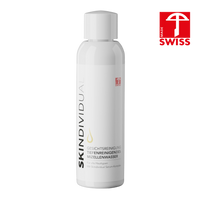
2. Cleanse your face Your skin must be completely free of make-up, sun cream, and sebum before rolling. Cleanse your face thoroughly with a gentle micellar water – it removes residue gently without irritating or drying out the skin.
The SKINDIVIDUAL Micellar Water is ideal as a first step because it does not burden the skin with alcohol or harsh surfactants.
3. Disinfect the derma roller Before each use, place your derma roller in 70% isopropyl alcohol for 5–10 minutes or spray it generously. Then let it air dry – do not wipe it. This step is non-negotiable, because sterile means safe.
4. Apply serum before rolling Now apply a hyaluronic serum or vitamin C to the cleansed skin – both active ingredients benefit from the skin already absorbing them immediately before rolling.
Important: Do not use retinol directly before use, as it can cause significant irritation in combination with the micro-channels.
Safety note: Essential oils, retinol, and acid-based exfoliants have no place in your derma roller routine – neither before nor directly afterwards. They can trigger irritation or even inflammation in the open micro-channels.
5. Roll – technique makes the difference Roll each zone in three directions: horizontal, vertical, and diagonal – 3–4 passes per direction. Apply only light pressure – you should feel a gentle tingling, but no pain.
Lift the roller slightly after each pass rather than dragging it – this protects both the needles and your skin.
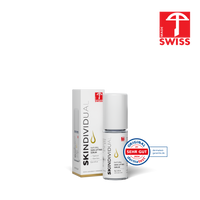
6. Apply serum and aftercare Immediately after rolling, the micro-channels are maximally receptive – make the most of this moment. The Natural Skin Lifting Serum by SKINDIVIDUAL with Spilanthol, hyaluronic acid, and Centella Asiatica supports regeneration precisely at this point and gives your skin what it needs for visible firming.
7. Clean and store the derma roller Rinse the roller under lukewarm water after use, disinfect it again with alcohol, and let it dry completely. Store it in the supplied protective cap – this keeps the needles precise and hygienic until your next step-by-step session.
The Right Rolling Technique: How to Proceed
Now comes the decisive moment: the actual derma roller application. With the right technique, you get the maximum out of every step-by-step session.
- Forehead: Start at the top and roll horizontally, vertically, and diagonally – 3–4 strokes per direction. Light pressure is sufficient.
- Cheeks: Work from the nose towards the temples. Lift the roller briefly after each pass rather than dragging it.
- Chin and jaw: Roll from the centre outwards. The same applies here: three directions, gentle pressure.
- Nose area: Only with caution and small movements – the skin here is more delicate.
- Eye contour: Please skip this area – this zone is too thin and sensitive for the roller.
- Feeling a gentle tingling? Perfect. Pain is a sign to reduce the pressure.
- Stay consistent: Treat each zone equally often – this produces a balanced result across the face.
Which Active Ingredients Pair Well with the Derma Roller?
After rolling, your skin is in a unique state: the fine micro-channels are open, and active ingredients now penetrate up to 40 times deeper than usual.
Hyaluronic acid is your best ally at this moment – it binds moisture directly in the deeper skin layers and supports regeneration immediately. Equally welcome are vitamin C, peptides, and Spilanthol, the natural active ingredient in the Natural Skin Lifting Serum, which visibly firms and revitalises the skin.
What you should absolutely avoid now: retinol and AHA acids – both are too intense immediately after rolling and can irritate the sensitised skin. Wait at least 24 hours before reintroducing these ingredients. Your serum for moisturising directly after use should therefore be chosen deliberately – gentle, nourishing, and highly effective.
How Often Should You Use the Derma Roller?
 How often you should use the derma roller depends primarily on the needle length – and on how well your skin can recover between sessions.
| Needle Length | Recommended Frequency |
|---|---|
| 0.25 mm | Daily to 3× per week |
| 0.5 mm | 1× per week |
| 1.0 mm | Every 3–4 weeks |
More is not better here: If you use your derma roller too frequently, you risk chronically irritated skin rather than an improved complexion. Give your skin the time it needs – the visible results emerge during the regeneration phase, not during the derma roller application itself.
The season also plays a role. In summer, consistent sun protection after use is even more important, as the skin reacts more sensitively to UV radiation.
In winter, the skin tends to dry out – here it is especially worthwhile to apply hyaluronic acid straight after rolling to replenish moisture reserves effectively. This way, you adapt your routine intelligently to the season and get the maximum from every session.
Cleaning and Storing Your Derma Roller Properly
A clean derma roller is the foundation of every safe derma roller routine – and cleaning is quicker than you think. Here is how to do it correctly:
- Rinse: Hold the derma roller under lukewarm water immediately after use and rinse coarse residue from the needles. No soap, no scrubbing.
- Disinfect: Place the roller head in 70% isopropyl alcohol for 5–10 minutes or spray it generously. This step is not optional – it protects you from bacteria and contaminants.
- Air dry: Allow the derma roller to dry completely in the air before putting it away. Never rub it dry – this bends the fine needles.
- Store: Keep it in the original case, protected from dust and direct sunlight.
A clean derma roller is not a nice-to-have – it is a prerequisite for safe use.
Regarding durability: even high-quality derma rollers have their limits. After approximately 10–15 uses, the needles become dull – even if you can barely see it with the naked eye.
Dull needles irritate the skin unnecessarily instead of stimulating it gently. When in doubt: replace it sooner rather than later.
Who Is the Derma Roller Suitable For – and Who Should Avoid It?
The derma roller is a versatile tool – but it is not suitable for every skin type and every situation. Knowing when you can use it and when it is better to abstain is just as important as the correct derma roller technique itself.
Well suited for:
- Fine lines and early wrinkles
- Superficial scars (e.g. faded acne scars)
- Stretch marks
- Dull, tired complexion lacking radiance
- Early visible signs of ageing from 30 onwards
Better to avoid with:
- Active acne or inflamed skin areas
- Rosacea or couperose – the needles can worsen redness and irritation
- Open wounds, herpes, or other skin infections
- Pregnancy and breastfeeding
- Use of blood thinners or strong medications (consult your doctor)
If you have sensitive skin, this does not automatically mean that microneedling is off-limits. Simply start with a shorter needle length of 0.25 mm and reduce the frequency to once every two weeks.
Your skin will show you what it can tolerate – listen to it.
Safety is not the opposite of visible results. Those who proceed mindfully protect their skin and achieve better outcomes in the long run.
Derma Roller for Sensitive Skin: A Gentle Approach
Sensitive skin does not require giving up – it requires an adapted derma roller routine. Start with a 0.25 mm needle length: this depth stimulates your complexion without compromising the skin barrier.
Reduce the frequency to once every two weeks and observe how your skin responds. Avoid pressure and let the roller glide gently. Less truly is more here – your goal is a slight redness, not irritation.
Those who proceed mindfully reward their skin with lasting results.
Frequently Asked Questions
Does derma rolling hurt?
With a needle length of 0.25 mm, the application is barely noticeable – you will feel at most a gentle tingling. Longer needles (from 0.5 mm) can produce a more intense sensation, but are generally not recommended for home use.
How long until I see results?
Initial improvements in your complexion typically appear after 4–6 weeks of regular use.
Since collagen takes time to build up, microneedling achieves its full effect with consistent, patient application over several months.
Can I use the derma roller on stretch marks?
Yes – the derma roller is also suitable for the body and can support skin regeneration for stretch marks. Choose an appropriate needle length and start gently to gauge your skin's reaction.
Can I apply make-up after the treatment?
Immediately after rolling, the skin is more sensitive and the pores are open – wait at least 12 hours before applying make-up. This helps you avoid irritation and allows your skin to regenerate optimally.
What should I do if my skin is red after rolling?
Slight redness is perfectly normal and usually subsides within a few hours. Cool the skin gently, avoid active ingredients such as retinol, and give your skin time to recover.
Can I combine the derma roller with a hyaluronic serum?
Absolutely – applying a hyaluronic serum immediately after derma rolling is ideal because the skin can absorb the ingredient particularly deeply.
The [Natural Skin Lifting Serum](https://skindividual.ch) by SKINDIVIDUAL with hyaluronic acid and Spilanthol is an excellent choice for this purpose.
Does derma rolling hurt?
With a needle length of 0.25 mm, derma rolling is barely noticeable – most people describe it as a gentle tingling. From 0.5 mm, the sensation becomes more intense, which is why this length is not recommended for home use.
How long until I see results?
Initial improvements to your complexion often appear after just two to four weeks – fine lines look softer, the skin more radiant.
For deeper wrinkles or scars, collagen production needs a little more time: allow at least eight to twelve weeks.
Can I use the derma roller on stretch marks?
Yes, the derma roller is also excellent for stretch marks on the abdomen, thighs, or buttocks.
For these body areas, slightly longer needles are recommended – ideally 0.5 to 1.0 mm – to effectively reach the deeper skin layers and stimulate collagen production.
Which serum is best after the treatment?
After derma rolling, your skin absorbs active ingredients particularly deeply. Make the most of this moment with a high-quality serum containing hyaluronic acid or vitamin C – ideal for intensive moisturising and visible firming.
The [Natural Skin Lifting Serum](https://skindividual.ch) by SKINDIVIDUAL is the perfect choice for this.
Can I apply make-up after derma rolling?
After derma rolling, your skin is sensitive – wait at least 24 hours before applying make-up. Thorough cleansing protects the skin from irritation.