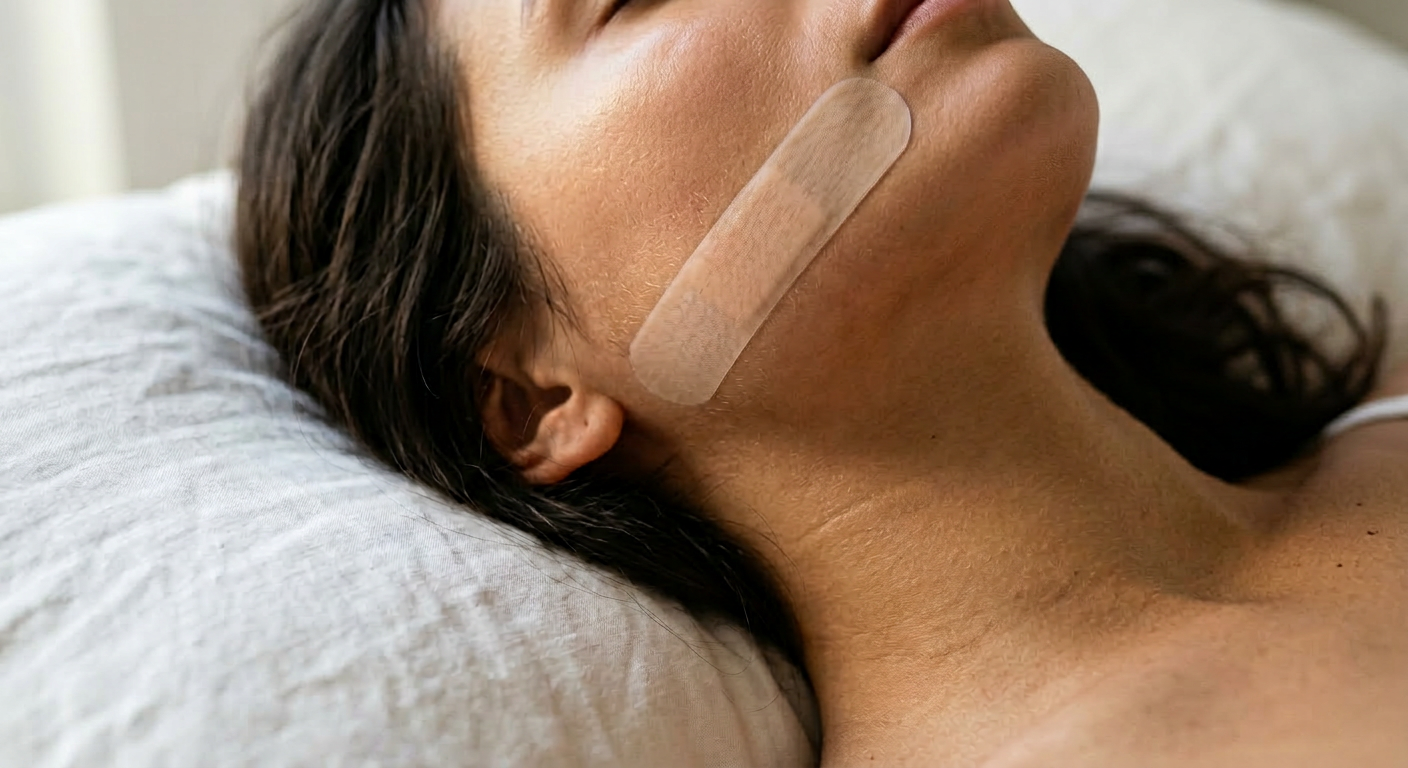
Waking up in the morning and staring straight at deep forehead wrinkles — many of us know the feeling. No wonder face taping is popping up everywhere: as a simple, natural method to reduce wrinkles while you sleep.
Small adhesive strips on the skin, big results — at least that's what the trend promises.
But what's really behind it? And is it worth integrating face taping into your evening routine?
In this article, you'll discover how face taping works, what the science says — and how to use it safely and correctly.
Face Taping: The Trend That Promises to Smooth Wrinkles Overnight
Morning in the bathroom, the light still dimmed — and yet you see them: the first fine lines around your eyes and mouth, slowly making themselves known. No cause for alarm, but perhaps the moment you start taking an interest in new anti-ageing approaches.
This is exactly where face taping comes in — a beauty trend that's shaking up the skincare world. With special adhesive strips worn on the skin overnight, wrinkles are gently smoothed and facial muscles relaxed. Sounds simple, but it works surprisingly cleverly.
Beauty taping has its roots in physiotherapy and is now finding its way into daily skincare routines — entirely without needles or aggressive procedures.
What Exactly Is Face Taping?
Face taping refers to a method in which special adhesive strips are strategically applied to specific areas of the face — with the aim of mechanically smoothing wrinkles and relaxing the underlying muscles.
The principle originally comes from sports medicine and physiotherapy, where kinesio tape has been used for decades to support muscles and joints. Beauty enthusiasts have adapted this technique and discovered it for daily facial care.
There are fundamentally two forms of application:
With night taping, you apply the strips before going to bed and leave them to work overnight. This prevents you from unconsciously pulling faces or pressing your face into the pillow while sleeping — both well-known causes of ingrained sleep wrinkles.
Day taping, on the other hand, relies on the gentle pull of the strips to consciously relieve the facial muscles and visually tighten the skin.
As a non-invasive Botox alternative without needles or downtime, beauty taping particularly appeals to those who favour natural methods — and all from the comfort of home.
Kinesio Tape vs. Beauty Tape: What's the Difference?
Not all tapes are the same. Here's a quick overview so you know what you're working with:
- Kinesio tape comes from physiotherapy and was originally developed for muscles and joints — elastic, breathable and skin-friendly
- Beauty tape is a variant specially adapted for the face: thinner, gentler and often more transparent than classic kinesio tape
- Both tape types are used in face taping, depending on preference and availability
- Kinesio tape comes in various widths — narrow strips work best for the face
- Beauty taping products are often pre-cut and designed for specific facial areas
- Both variants work on the same basic principle: gentle tension that lifts the skin and relieves the muscles
How Does Face Taping Work — and What Does the Science Say?
 The principle behind face taping is remarkably simple — and that's precisely what makes it so convincing: the tape mechanically fixes the skin and prevents the same wrinkles from being etched in again and again through facial expressions or sleeping positions.
Particularly at night, when you lie in the same position for hours, deep sleep wrinkles develop through repeated pressure and tension — face taping targets precisely this.
The short-term effect is well explained by science: through the gentle pull of the tape, the skin is slightly lifted, the underlying facial muscles are relieved and wrinkle formation through facial expressions is reduced. Many report visibly smoother skin after a night with tape — this isn't imagination but a real, albeit temporary, effect.
Dermatologists emphasise that face taping can mechanically inhibit wrinkle formation — but has no influence on collagen production or the skin structure itself.
Long-term studies on regular use are still rare. What skin experts unanimously recommend:
- Understand face taping as a complementary method — not a replacement for a solid skincare routine
- Combine it with active ingredient-rich care, such as hyaluronic acid or spilanthol
- Support the skin from within and sustainably prolong the visible smoothing effect
The combination makes the difference.
What Dermatologists Say on the Topic
Dermatologists agree: face taping can mechanically slow the development of wrinkles — especially those caused by sleeping positions and facial expressions.
At the same time, skin doctors emphasise that the effect remains on the surface. Anyone wanting to achieve long-term results needs an anti-ageing routine that works deeper. Active ingredients like hyaluronic acid and spilanthol work directly within the skin structure — they promote moisture retention and support natural firmness.
Face taping and targeted skincare don't exclude each other; quite the opposite: combined, they deliver their best results.
Step-by-Step Guide: How to Apply Face Taping Correctly
Face taping only works properly when applied correctly. With this step-by-step guide, you'll master your beauty taping routine from the very first evening.
Thoroughly cleanse the skin Start with a clean base. Remove make-up, sebum and impurities completely — ideally with a gentle micellar water that won't dry out the skin. Residue under the tape can cause irritation.
Let the skin dry completely Wait until your skin is fully dry. On damp or oily skin, the tape barely adheres — and comes loose at night precisely when you need it least.
Cut the tape to the right length Cut the strips to fit:
- For the forehead, longer, horizontal pieces work well.
- For the eye area, use shorter strips that you carefully place at the outer corners of the eyes.
- For nasolabial folds, cut narrow strips that you apply along the crease.
Gently stretch the skin and apply the tape Pull the skin gently with your fingers in the desired direction and stick the tape on without excessive pressure. Never apply tape to irritated, reddened or very dry skin — this can strain the skincare barrier.
Carefully remove the tape in the morning Peel off the tape slowly and always in the direction of hair growth. No tearing — your skin will thank you for the patience.
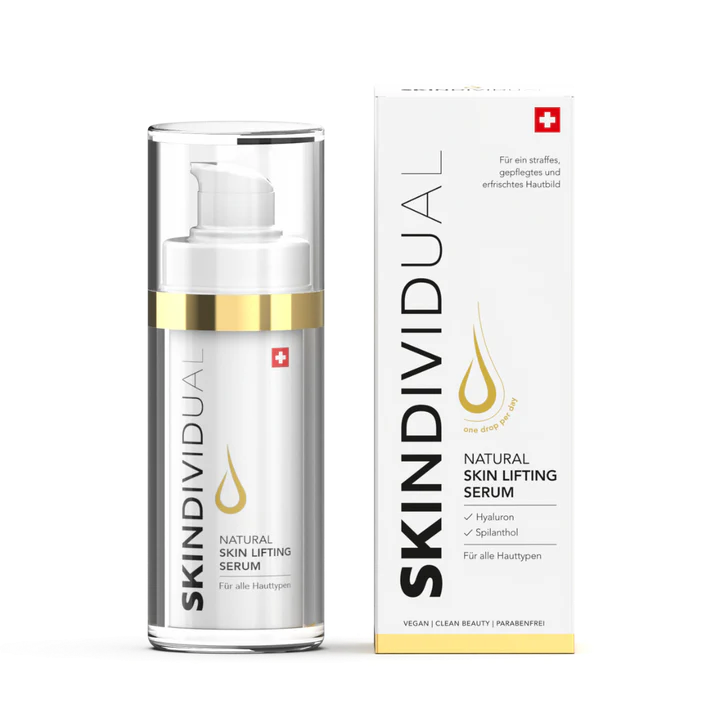
Care for the skin immediately After removal, the skin needs attention. The Natural Skin Lifting Serum with spilanthol and hyaluronic acid provides the skin with moisture directly after face taping. It supports natural firmness — from within, where tape cannot reach.
Face Taping for Different Facial Areas
Face taping works wherever wrinkles develop — you just need to know where to start:
- Forehead: Horizontal strips smooth transverse wrinkles and help to reduce nighttime brow raising
- Eye area: Short, diagonally placed strips at the outer corners of the eyes soften fine crow's feet — ideally combined with the Hyaluron Eye Gel Roll-On
- Nasolabial folds: Narrow strips along the crease gently plump deeply etched wrinkles
- Glabellar lines (between the brows): Small, vertical pieces relax the typical frown lines
- Décolletage: Underestimated but effective — wide strips noticeably reduce sleep wrinkles overnight
- Neck area: Fine horizontal strips support the delicate, often neglected neck skin during beauty taping
Risks and Side Effects: What You Should Know
 Face taping is well tolerated by most people — yet it's worth keeping a few points in mind before you begin.
- Patch test first: Before your first application, stick a small test strip on an inconspicuous area and wait 24 hours. This way, you'll spot early whether your skin reacts to the adhesive.
- Possible skin irritation: Slight redness after removal is normal and usually fades quickly. Persistent irritation is a signal to take a break.
- Caution with sensitive skin: If you're prone to rosacea or active acne breakouts, avoid face taping for now and consult a dermatologist first.
- Correct removal is crucial: Always peel off the tape slowly and in the direction of hair growth — never abruptly. Damp wiping makes removal easier.
- No permanent use: Give your skin regular breaks so it can breathe.
- Skincare afterwards: Treat your skin after taping with a moisturising skincare product — your skin stays supple and well-nourished this way.
Face Taping as a Botox Alternative — a Realistic Assessment
Face taping sounds tempting — but how does it really compare to professional treatments or a consistent skincare routine? Here's an honest look at the options:
| Criterion | Face Taping | Botox | High-Efficacy Skincare |
|---|---|---|---|
| Cost | Very low (approx. 10–30 CHF) | High (200–600 CHF per session) | Medium (one-time investment) |
| Duration of Effect | Temporary (hours) | 3–6 months | Long-term with regular use |
| Risks | Minimal (skin irritation possible) | Medical risks, side effects | Very low with high-quality ingredients |
| Naturalness | High | None | High (depending on formula) |
| Accessibility | Very easy, usable at home | Only through professionals | Easy, usable daily |
Face taping is not a replacement for Botox — but a low-risk, cost-effective addition that you can incorporate into your routine entirely without a doctor's appointment.
Anyone wanting to combat wrinkles long-term and naturally is best served by a combination: face taping for the short-term effect — and active ingredient-rich skincare as a sustainable strategy.
The Natural Skin Lifting Serum from SKINDIVIDUAL with spilanthol — the plant-based Botox alternative — helps the skin to appear visibly firmer and more youthful. Entirely without needles, entirely without compromise.
Skincare After Face Taping: How to Optimally Care for Your Skin
 As soon as you remove the tape, your skin deserves special attention. First, gently cleanse it with a micellar water — it removes adhesive residue without a trace, without irritating the skin.
Then it's the perfect moment to deliver valuable active ingredients: hyaluronic acid provides instant moisture, collagen supports elasticity, and spilanthol — the plant-based lifting active in the Natural Skin Lifting Serum — helps the skin to prolong the tightening effect of taping long-term. For the delicate eye area, the Hyaluron Eye Gel Roll-On is additionally recommended, as it specifically soothes puffiness and cares for the delicate skin around the eyes.
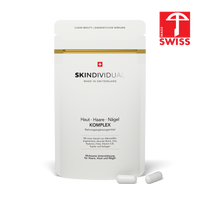
Beauty also comes from within: the Skin, Hair, Nails Complex with biotin and collagen complements your facial care at a cellular level — for sustainably radiant skin that shows.
FAQ: Frequently Asked Questions About Face Taping
Frequently Asked Questions
How long should you wear face tape?
Ideally 4–8 hours, for example overnight. You shouldn't wear the tape for longer than 8 hours so the skin can breathe and no irritation develops.
Can face taping permanently reduce wrinkles?
Face taping doesn't smooth wrinkles permanently but can positively influence muscle habits with regular use.
Combined with high-quality skincare, the effect remains visible for longer.
Which tape is suitable for sensitive skin?
For sensitive skin, skin-friendly kinesio tape or special beauty taping products without aggressive adhesives are recommended.
Test the tape on a small area beforehand to rule out reactions.
How often should you apply face taping?
3–5 times per week is a good rhythm. This gives your skin enough time to regenerate without interrupting the anti-ageing effect.
Is face taping a genuine Botox alternative?
Face taping is a gentle, natural Botox alternative without needles or active substances — ideal for anyone who wants to appear wrinkle-free without procedures.
The results are subtler, but completely risk-free and noticeably effective with supporting skincare.