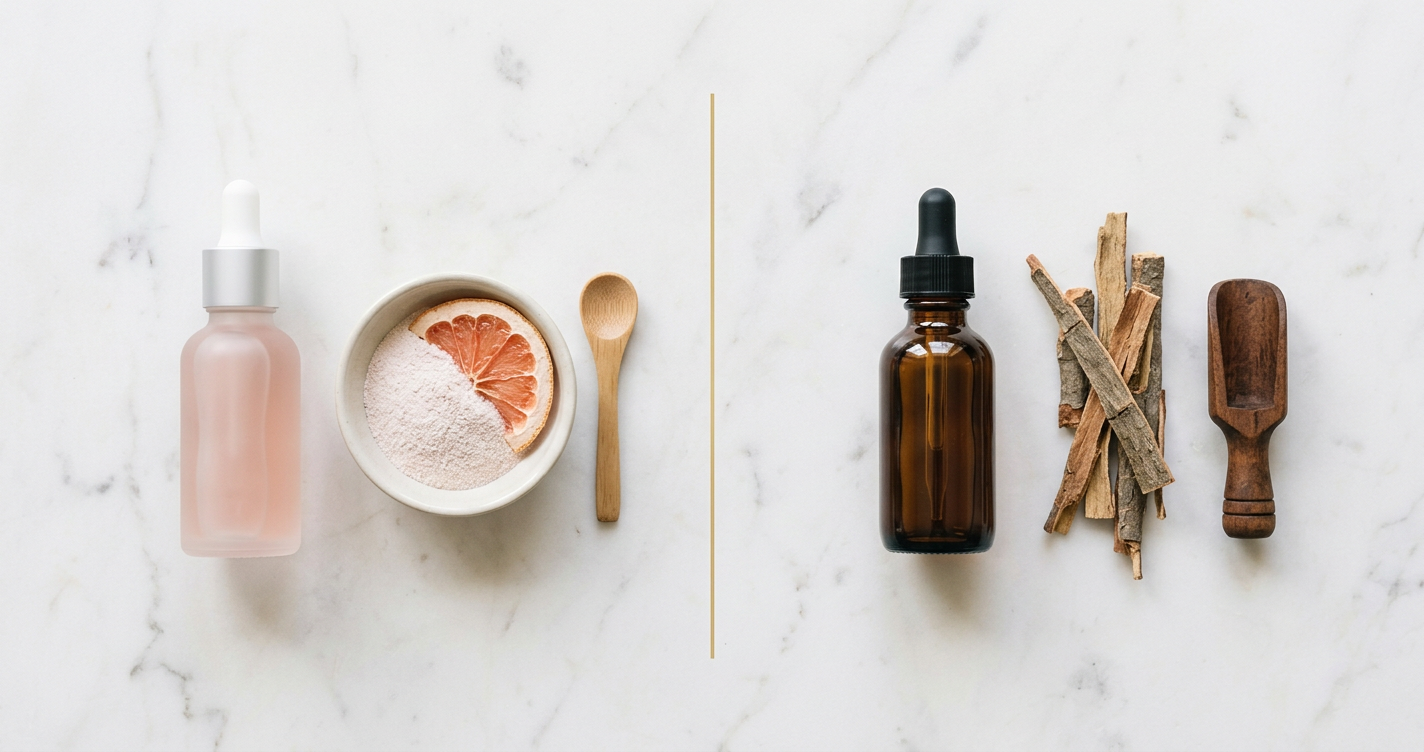
You're standing in the aisle — or scrolling through an online shop — wondering: AHA or BHA? Both actives promise brighter, more even skin. But which one is actually right for you?
AHA vs BHA is one of the most common skincare questions — and rightly so. While both are chemical exfoliants, they work in fundamentally different ways: on different layers of the skin, for different skin types.
AHAs like glycolic acid smooth the skin's surface and target hyperpigmentation. BHAs like salicylic acid penetrate deep into the pores and regulate excess sebum.
Understanding this distinction helps you make better decisions for your skin — instead of blindly following trends. In this article, you'll learn how both actives work, which one suits your skin type and how to safely incorporate them into your routine.
AHA vs BHA: Which Exfoliant Suits Your Skin?
You're standing in the aisle — or scrolling through an endless online shop — wondering: AHA or BHA? Both are considered powerful exfoliants, both promise radiant skin, and both sound like exactly what you need. But which is the right one for you?
The good news: You don't need a cosmetics degree to make the right choice. AHA vs BHA is less of an either-or and more of an understanding question — and once you know how these two acids work, the decision becomes surprisingly straightforward.
In short: Both actives gently dissolve dead skin cells and help your skin renew itself. But they do so in different ways and are suited to different skin types and concerns.
In this article, you'll learn:
- what sets AHA and BHA apart
- which active suits your skin type
- how to integrate them sensibly into your daily routine
What Are AHAs — and What Do They Do in Your Skincare Routine?
 Alpha hydroxy acids — AHAs for short — are naturally occurring acids originally derived from fruits, milk or almonds. What makes them special: they are water-soluble and work exclusively on the skin surface — exactly where you need them most.
AHAs dissolve the bonds between dead skin cells, allowing them to shed gently — no scrubbing, no rubbing, just chemistry working for your skin.
This mechanism sounds simple but has impressive effects. When dead skin cells build up, the complexion looks dull and early fine lines become more pronounced. At the same time, hyperpigmentation — dark spots and uneven skin tone — becomes more visible.
AHAs literally clear the way: they accelerate the skin's natural cell renewal and reveal fresh, radiant skin underneath.
The AHA family includes several acids that differ slightly in molecular size and penetration depth:
- Glycolic acid: The most well-known and extensively researched AHA. Its small molecular size makes it particularly effective, making it the top choice for anti-ageing and dark spots.
- Lactic acid: Slightly larger molecules, gentler action — ideal for more sensitive skin. Also helps bind moisture.
- Mandelic acid: The mildest of the three, perfect for beginners or highly reactive skin.
Who benefits most from AHAs? Primarily dry skin and normal skin that suffers from dullness, uneven texture or early signs of ageing.
Since AHAs work exclusively on the surface, they don't reach clogged pores. However, they excel at refining the complexion, softening the skin and improving the absorption of subsequent skincare products.
In short: if your skin needs more radiance, evenness and suppleness, AHAs are your natural ally.
The Key AHA Acids at a Glance
Not every AHA is the same — their molecular size determines how deeply they penetrate and how well your skin tolerates them:
- Glycolic acid: The star among AHA acids. Its small molecule makes it the most effective exfoliant — particularly powerful against dark spots and early signs of ageing.
- Lactic acid: Slightly gentler than glycolic acid, but doubly useful: it exfoliates and moisturises simultaneously — ideal for more sensitive skin.
- Mandelic acid: The mildest option. Perfect if you're new to acid-based skincare or your skin reacts quickly.
- Tartaric acid & citric acid: Less commonly used as primary actives, but valuable supporting ingredients in combined formulas.
Who Benefits Most from AHAs?
AHAs are a real asset — especially if you struggle with dry skin, fine lines or hyperpigmentation. This is precisely where they deliver their strongest results: they dissolve dead skin cells, promote cell regeneration and visibly even out the skin texture.
Anyone noticing early signs of ageing and looking for natural anti-ageing alternatives is also on the right track with AHAs. Sensitive skin benefits most from milder variants like mandelic or lactic acid — gentle yet effective.
What Are BHAs — and Why Do Your Pores Love Them?
 Beta hydroxy acids — BHAs for short — have a special property that fundamentally sets them apart from AHAs: they are oil-soluble. This might sound like a technical detail, but it makes all the difference for your skin.
Because BHAs are oil-soluble, they can cut through your skin's natural sebum and penetrate directly into the pore — clearing out exactly where it's needed most.
The best-known and most thoroughly researched BHA is salicylic acid. It has been used in dermatology for decades — and for good reason.
While AHAs mainly work on the skin surface dissolving dead cells, salicylic acid goes deeper. It penetrates the pore canal, dissolves trapped sebum and impurities, and simultaneously has a mild anti-inflammatory effect. For skin prone to acne, blackheads or clogged pores, this brings real relief.
Oily skin benefits most from this mechanism. When sebum and dead skin cells accumulate in the pores, the typical blemishes many of us know appear. BHAs clear this congestion before it becomes visible — and can refine the skin texture and visibly reduce pore size over time.
A persistent myth: BHAs are more aggressive or irritating than AHAs. That's not quite true. BHAs simply work differently — more targeted, deeper, but not necessarily more intense. If you have sensitive skin but are also prone to blemishes, you can start with a low concentration of salicylic acid and observe how your skin responds.
In summary, BHAs are particularly suited for:
- Oily or combination skin with a shiny T-zone
- Skin with blackheads and clogged pores
- Skin prone to acne or blemishes
- Anyone wanting to refine pores and smooth the skin texture
Salicylic Acid: The Best-Known BHA
Salicylic acid is the most well-known BHA — and simultaneously one of the most thoroughly researched substances in modern dermatology. As an oil-soluble acid, it penetrates deep into the pore canal, dissolves trapped sebum and has a mild anti-inflammatory effect at the same time.
This is precisely what makes it so valuable for acne, blackheads and clogged pores: rather than just working on the surface, salicylic acid tackles the issue directly at its source. For oily or blemish-prone skin, this is a genuine game-changer — because it fights impurities before they even become visible. Over time, the skin texture refines itself and pores appear visibly smaller.
Who Benefits Most from BHAs?
BHAs are the right choice when your skin tends towards oiliness, acne or clogged pores. If you regularly battle blackheads, pustules or a shiny T-zone, you'll benefit enormously from the deep-acting power of salicylic acid.
Even oily skin with uneven texture or enlarged pores can see visible improvements with BHA. Combination skin with oily zones also responds well.
BHAs are less ideal for very dry or sensitive skin — over time, the acid can be drying. When in doubt: start with a low dose and observe how your skin reacts.
AHA vs BHA: The Key Differences at a Glance
 Whether AHA or BHA — both groups of actives are powerful exfoliants that can visibly refine your skin. The crucial difference lies in their chemistry:
- AHAs are water-soluble and work primarily on the skin surface
- BHAs are oil-soluble and penetrate deep into the pores
This single difference determines everything — which type suits you, what it delivers and how to use it correctly.
| Feature | AHA | BHA |
|---|---|---|
| Solubility | Water-soluble | Oil-soluble |
| Penetration depth | Skin surface, upper layers | Deep into the pores |
| Key actives | Glycolic acid, lactic acid, mandelic acid | Salicylic acid |
| Best skin types | Dry, mature, normal skin | Oily, acne-prone, combination skin |
| Main benefits | Fine lines, anti-ageing, hyperpigmentation | Acne, blackheads, pore size |
| pH range | 3.0–4.0 (optimally effective) | 3.0–4.0 (optimally effective) |
| Application frequency | 2–3 times per week | 2–3 times per week |
The pH value matters: if it's above 4.0, both acids lose a significant part of their effectiveness. A well-formulated product communicates this value transparently — that's a reliable quality indicator.
In summary: if you're battling early wrinkles, uneven complexion or hyperpigmentation, AHA is your ally. If clogged pores, shine and acne bother you, reach for BHA. And if both apply? Then you can alternate between both — your skin will thank you.
Which Exfoliant Suits Your Skin Type?
Choosing the right one is easier than you might think — once you know what to look for.
Dry or mature skin benefits most from an AHA exfoliant. Glycolic acid and lactic acid work on the skin surface, gently dissolving dead skin cells while simultaneously promoting moisture retention. If fine lines, hyperpigmentation or a tired, uneven complexion concern you, AHA is your reliable companion.
A widespread myth: AHA is fundamentally more aggressive than BHA. That's not true. What matters is the concentration and pH value — not the active group itself. Mandelic acid, for example, is considered particularly mild and is suitable even for more sensitive skin.
Oily skin, combination skin with blemishes or acne-prone skin responds better to BHA. Salicylic acid is oil-soluble and penetrates deep into the pores — exactly where sebum, dirt and bacteria settle. This makes it the most effective tool against blackheads, shine and acne. BHA also regulates sebum production, which leads to a refined skin texture over time.
Sensitive skin or combination skin deserves a more considered approach. Start with a low concentration, maximum twice a week, and observe how your skin responds. Some skin types tolerate both acids well — used alternately, on different days.
An often-forgotten aspect: Seasonal differences play a role. AHA increases the skin's light sensitivity — in summer, sun protection isn't optional, it's essential. BHA can be used year-round, even in summer, as it makes the skin less photosensitive.
In short:
- Dry, mature, early wrinkles, hyperpigmentation → AHA
- Oily, acne, clogged pores → BHA
- Sensitive or combination skin → start with a low dose, observe, possibly combine
Acids don't need to be intimidating. Used correctly, they're one of the most effective tools you have for your skin — and with the right knowledge, you'll make the choice that truly suits you.
Dry and Mature Skin: AHA as the First Choice
Dry and mature skin benefits most from an AHA exfoliant — that's the clear recommendation. Glycolic acid works directly on the skin surface, gently dissolving dead cells while simultaneously promoting moisture retention. Exactly what dry skin needs.
If fine lines, an uneven complexion or early signs of ageing concern you, AHA is your most reliable ally in your daily anti-ageing routine. Important to know: it's not the active group that determines tolerability, but the concentration and pH value. Mandelic acid, for example, is considered particularly mild — ideal if your skin is somewhat more sensitive.
Oily Skin and Acne: BHA Gets to the Core
Oily skin, clogged pores and recurring acne — here, BHA is the superior choice. Unlike AHA, salicylic acid is oil-soluble and can penetrate deep into the pore, dissolving excess sebum and tackling blackheads at the root. This makes it the first choice for oily and blemish-prone skin.
At the same time, it has a mild anti-inflammatory effect — a real advantage if your skin tends towards redness. So if you're battling acne, shiny skin or visibly enlarged pores, a BHA exfoliant is exactly what your routine needs.
Sensitive and Combination Skin: Finding the Balance
If you have sensitive skin or combination skin, it's worth taking a closer look before incorporating an exfoliant into your routine. With sensitive skin, AHA acids like glycolic acid can initially cause redness or tingling — so start with low concentrations and exfoliate once or twice a week at most.
BHA is often the gentler alternative here, as salicylic acid also has a calming effect. For combination skin, a combined approach works well: BHA for the oily T-zone, AHA for drier areas. In any case, skip exfoliants when your skin is currently irritated, red or stressed by external factors.
How to Use AHA and BHA Correctly
Acids sound more complicated than they are — with the right approach, you can integrate AHA and BHA into your routine with ease.
Cleanse your face thoroughly first. An exfoliant can only work properly on clean skin.
Important: the pH of your skin is slightly elevated after cleansing. Wait around 20–30 minutes before applying the acid, or use a mild alcohol-free toner. AHA and BHA need a slightly acidic environment (pH 3–4) to deliver their full exfoliating effect.
Apply the exfoliant precisely. Start with once or twice a week — in the evening, not in the morning. Apply BHA preferably to the T-zone, AHA to drier areas.
Less is more at the beginning: let your skin adapt gradually without overwhelming it.
Follow immediately with moisturising care. This is where hyaluronic acid comes in: it soothes, plumps and compensates for the moisture loss after exfoliation.
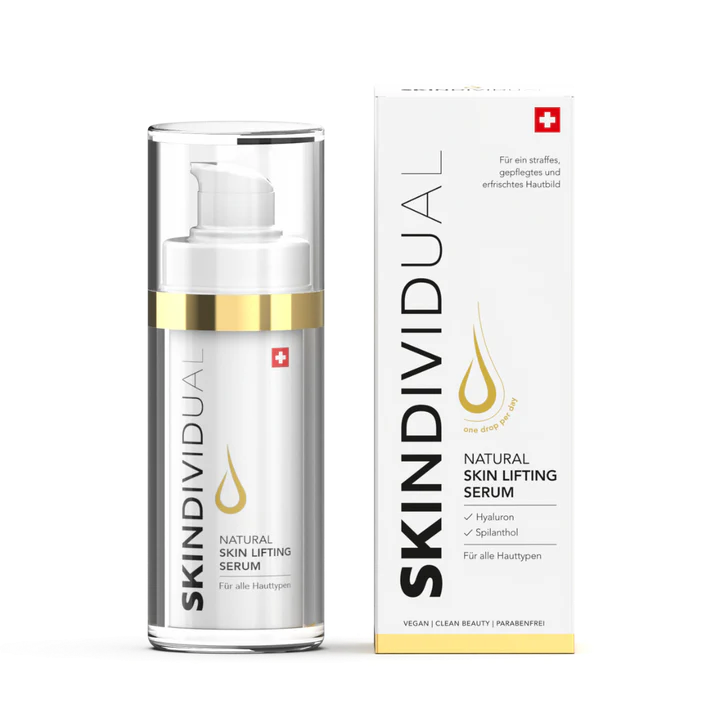
The Hyaluron Eye Gel Roll-On from SKINDIVIDUAL is perfect as the next step — especially for the delicate eye area. Afterwards, you can apply a serum with spilanthol like the Natural Skin Lifting Serum, which naturally firms the skin and complements the anti-ageing effect.
Combine wisely — and avoid conflicts. Retinol and AHA/BHA at the same time? Better not — this can unnecessarily irritate the skin. Use retinol and acids on alternate evenings.
Sun protection is essential — not a bonus. AHA makes your skin more light-sensitive. Apply SPF 30 or higher every morning without fail, otherwise you risk exactly what you're trying to combat with the exfoliant: uneven pigmentation and premature ageing.
Acids aren't rocket science — they'll reward you with smoother, more radiant skin if you give them a little time.
Combining AHA and BHA: Is That Possible?
Yes, you can combine AHA and BHA — with a bit of finesse. Both exfoliants complement each other well because they work in different ways: AHA smooths the skin surface, BHA penetrates deeper into the pores.
If you have sensitive skin, start slowly: don't use both acids on the same evening, but alternate instead. This gives your skin time to adapt without becoming overwhelmed.
If you already have some experience with exfoliants, you can use both acids strategically — BHA on the T-zone, AHA on drier areas. Less is more, especially at the beginning.
Frequently Asked Questions About AHA and BHA
Frequently Asked Questions
What is the difference between AHA and BHA?
AHA (e.g. glycolic acid) works on the skin surface and smooths the texture — ideal for fine lines, hyperpigmentation and dry skin.
BHA (e.g. salicylic acid) is oil-soluble and penetrates deeper into the pores, making it your best ally against acne and oily skin.
Can I use AHA and BHA at the same time?
Yes — but with care. Start by alternating on different evenings so your skin can adjust. For sensitive skin: less is definitely more.
Which exfoliant helps with acne?
BHA, specifically salicylic acid, excels here: it dissolves sebum in the pores, reduces blackheads and targets blemishes — especially on the T-zone.
Is AHA or BHA better for wrinkles?
For anti-ageing and fine lines, AHA is the first choice. Glycolic acid stimulates cell renewal and visibly improves skin texture.
How often should I use an exfoliant?
Start with once or twice a week and increase gradually. If your skin responds well, you can carefully increase the frequency.
Redness is a clear sign to take a break.
Do I need sun protection after using AHA?
Absolutely. AHA makes the skin more light-sensitive — sun protection the morning after application is therefore essential. This protects your skin and maintains your results long-term.